Entropy and the God Who Brings Order Out of Chaos
Creation does not heal itself, and neither do we. From Genesis to Pentecost, Scripture reveals the Spirit of God bringing order, life and new creation out of chaos.
Leave a house alone long enough and it will not become cleaner. Dust gathers. Paint peels. Weeds push through cracks. Pipes corrode. The roof starts to sag. A garden left untended does not become Eden. It becomes thorns.
Leave a hot cup of coffee on the table and it cools. Spray perfume in one corner of a room and it spreads through the air. Leave a child’s bedroom alone for ten minutes and, unless that child is unusually sanctified, the room will not become more ordered. Clothes migrate. Books colonize the floor. Lego multiplies in darkness.
That is funny until you realize it is not only a household problem. It is woven into the physical world.
In science, this is connected to entropy. Entropy is often described as disorder, which is not the full technical definition, but it works well enough as a doorway. Energy spreads out. Heat moves from hot things to cold things. Concentrated things diffuse. Systems do not usually gather themselves into a neat, ordered and usable state without energy being put in from outside.
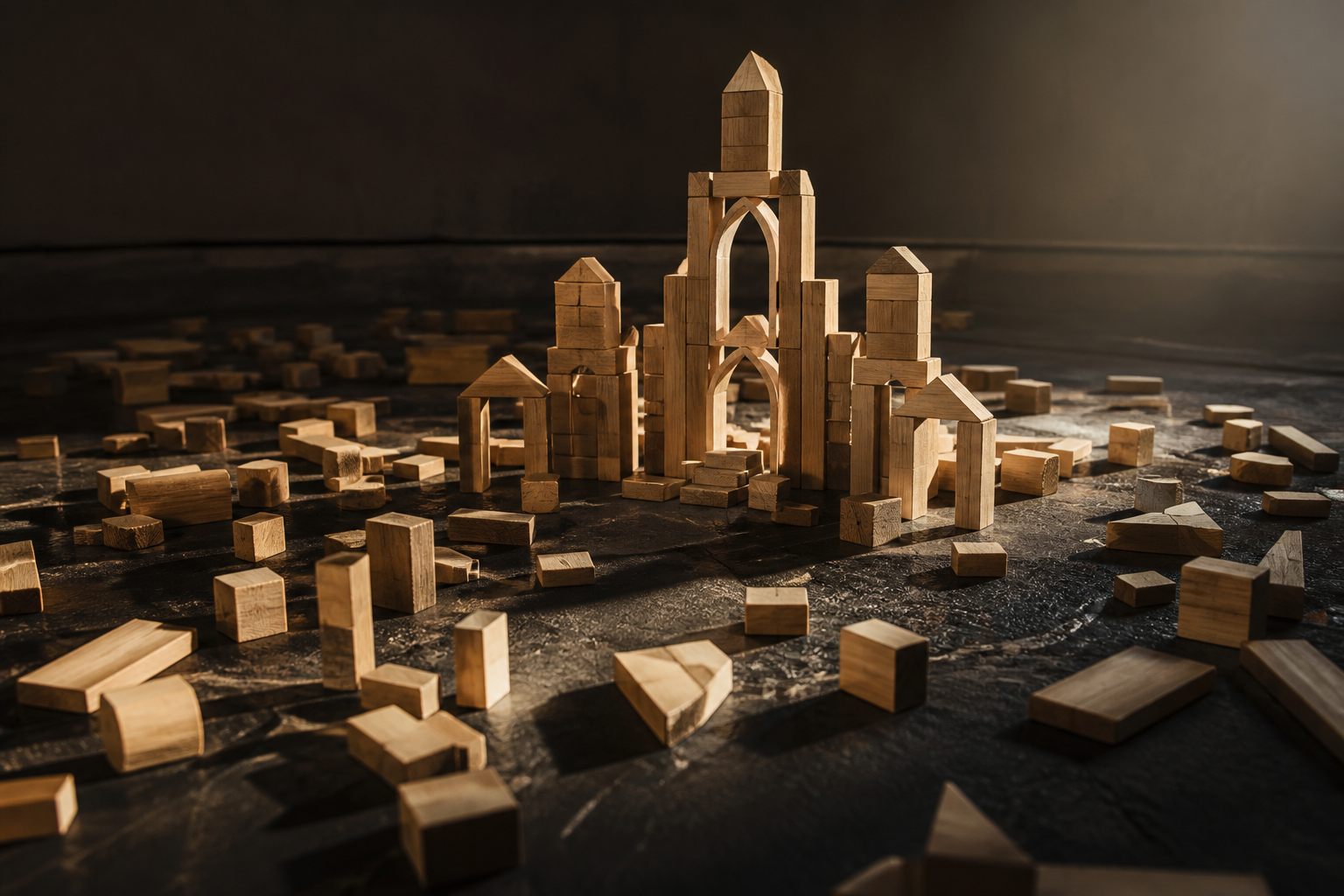
A tree can grow. A child can develop. A person can clean a room. Local order can increase. But it does not happen by accident. It requires energy, structure and life. Shake a box of building blocks and you may get noise. You will not get a cathedral.
That ordinary observation gives us a doorway into one of the great themes of Scripture: God brings order out of chaos.
The Bible begins with God and the unformed world.
“The earth was without form and void, and darkness was over the face of the deep. And the Spirit of God was hovering over the face of the waters.”
Genesis 1:2
Before there are trees, stars, rivers, birds, songs or human faces, there is darkness. There is the deep. There is the world described as without form and void.
And over it all, the Spirit of God hovers.
The first movement of creation is not human achievement. It is not nature organizing itself into beauty by sheer inner discipline. It is the presence of God over the chaos.
Then God speaks.
Light is separated from darkness. Waters are divided. Dry land appears. Plants rise from the earth. The sun, moon and stars are appointed for signs and seasons. Birds fill the sky. Fish fill the seas. Animals fill the land. Humanity is formed from the dust and given the breath of life.
Genesis 1 is not only telling us how things began. It is showing us what God is like. He brings form to formlessness, fullness to emptiness, light to darkness and life to dust.
The universe leaks order. God gives it.
That theme does not end with creation. When sin enters the world, Eden begins to unravel. Adam and Eve hide from God. Husband and wife turn blame into a shield. The ground brings forth thorns and thistles. Cain kills Abel. Violence spreads. Babel rises, full of human ambition and confusion.
Sin breaks rules, and it breaks communion. It disorders our loves. It bends worship inward. It turns desire into demand, strength into domination, freedom into slavery and knowledge into pride.
In that sense, sin works like a kind of spiritual entropy.
A soul left to itself does not become holy by accident. A marriage left untended does not become more tender. A church left to drift does not become more faithful. A culture given over to appetite and power does not become more humane.
The disorder can still look impressive. Babel was probably architecturally interesting. Spiritual chaos can wear expensive clothes. It can have technology, music, commerce, politics and ambition. Chaos does not always look like rubble. Sometimes it looks efficient and successful while the heart is disintegrating underneath.
That is why the Bible’s answer is never moral tidying. God does not hand humanity a broom and tell us to clean ourselves up.
He comes down.
That brings us to Pentecost.
In Acts 2, the disciples are gathered in Jerusalem. Jesus has died, risen and ascended. He has told them to wait for the promise of the Father. They are not to launch the mission in their own strength.
Then suddenly, there is a sound like a mighty rushing wind. Tongues like fire rest on them. They are filled with the Holy Spirit. People from many nations hear the mighty works of God declared in their own languages.
Pentecost is not a random miracle. It is creation language. It is Babel reversed. It is Genesis breathing again.
At Babel, human pride led to scattering and confusion. At Pentecost, the Spirit brings understanding across languages without erasing the nations. The miracle is not sameness. It is ordered diversity. Many peoples hear one gospel.
This is what God has always done. The Spirit hovers over the waters. The Spirit fills Bezalel for craftsmanship in the tabernacle. The Spirit comes upon the prophets. The Spirit gives life to dry bones in Ezekiel’s vision. The Spirit descends on Jesus at His baptism. The Spirit raises Jesus from the dead. The Spirit fills the church at Pentecost.
Everywhere the Spirit moves, dead things begin to stir. Scattered things are gathered. Dark things are illumined. Confused things become clear. Cowardly disciples become witnesses. Dry bones become an army. The old creation begins to hear the music of the new.
One of our mistakes is to treat the Holy Spirit as a religious enhancement, as though our natural life is the main thing and the Spirit adds a little warmth, courage or energy on top. A spiritual upgrade. A divine polishing cloth.
The Bible gives us something far better. The Spirit brings the life of the new creation.
Paul says:
“If anyone is in Christ, he is a new creation. The old has passed away; behold, the new has come.”
2 Corinthians 5:17
Christians do not instantly become perfectly ordered people. Anyone who has attended a church meeting knows better. But a new power is at work. The old downward pull of sin and death no longer has the final word. There is another wind now. Another life.
The Spirit convicts, comforts, teaches, sanctifies, unites, gives gifts, bears fruit, cries “Abba” in our hearts and conforms us to the image of the Son. Where sin pulls us apart, the Spirit gathers us into Christ. Where shame makes us hide, the Spirit brings us into sonship. Where pride turns language into confusion, the Spirit turns many tongues into praise. Where death reduces the body to dust, the Spirit promises resurrection.
Paul’s famous list in Galatians 5 is often read as a set of virtues, and rightly so.
“The fruit of the Spirit is love, joy, peace, patience, kindness, goodness, faithfulness, gentleness, self-control.”
Galatians 5:22-23
But notice the order in that fruit. Love reorders desire around God and neighbour. Joy reorders the heart around grace rather than circumstance. Peace brings fear under the rule of Christ. Patience changes how we live inside time and frustration. Kindness turns strength toward care. Goodness bends action toward what is morally beautiful. Faithfulness steadies our commitments. Gentleness places power under humility. Self-control brings appetite under love.
The fruit of the Spirit is not random religious niceness. It is the life of God bringing the soul back into harmony.
Many of us know what it is to feel inwardly disordered. Our thoughts scatter. Our desires conflict. We want holiness and comfort, Christ and control, forgiveness and resentment, prayer and distraction. We know what it is to be a divided house.
Trying harder may produce some outward order for a while. Discipline has its place. But discipline without the Spirit usually ends in pride or despair. The Christian life is not self-salvation by improved habits. It is life in the Spirit.
Romans 8 gives us one of the Bible’s deepest pictures of creation. Paul says creation was subjected to futility and now groans, waiting to be set free from its bondage to corruption.
That phrase, “bondage to corruption,” sounds almost like a theological description of the world we know. Creation is beautiful, but it is not yet free from decay. Bodies age. Stars burn out. Flowers fade. Civilizations crumble. Even the best things in this world are fragile.
But Paul says creation groans as in childbirth.
That changes the whole picture. The groaning of creation is not the sound of meaningless collapse. In Christ, it is the pain of coming renewal.
The story of Scripture is not creation, fall, decay, extinction. It is creation, fall, redemption and new creation. God does not abandon the world He made. The same Spirit who hovered over the first creation is bringing the new creation to birth.
Christian hope is not escape from creation. It is the renewal of creation.
Revelation does not end with souls floating in a disembodied heaven. It ends with the holy city, the new Jerusalem, coming down. It ends with the dwelling place of God with humanity. It ends with tears wiped away, death abolished and the curse removed.
The Bible begins with the Spirit over the waters. It ends with the river of the water of life.
That gives Pentecost its weight for ordinary people with disordered lives.
Where do I need the Spirit to bring order? Not superficial neatness. Not the appearance of being fine. Not the kind of order that impresses religious people while the heart remains untouched.
Perhaps there is disorder in my desires. Perhaps there is chaos in my thoughts. Perhaps bitterness has been allowed to grow wild. Perhaps fear has become a private weather system. Perhaps there are habits that keep dragging me back toward the old creation. Perhaps there is a relationship where language has become Babel and understanding feels impossible.
Pentecost says the Spirit still comes.
He comes because Jesus is exalted. He comes because the risen Christ keeps His promise. He comes to animate the church, not decorate it.
Without the Spirit, the church becomes an institution trying to preserve order by administration alone. With the Spirit, the church becomes a living temple.
Without the Spirit, doctrine can become cold, mission can become machinery, worship can become performance and morality can become self-improvement. With the Spirit, truth burns, mission breathes, worship rises, holiness flowers and Christ is made beautiful to us.
Natural things, when left to themselves, tend toward disorder.
The gospel announces that God has not left His creation to itself.
He spoke into darkness. He breathed into dust. He called Abraham. He delivered Israel. He filled the tabernacle. He sent the prophets. He overshadowed Mary. He raised Jesus from the dead. He poured out the Spirit. He is making all things new.
The world is not self-healing. Neither are we.
But the Spirit of God is not absent from the deep. He is the holy presence of God bringing creation to its intended glory. He is the breath of the risen Christ in His people. He is the firstfruits of the world to come.
Pentecost is not only a memory of fire once resting on the apostles. It is a promise.
The downward pull is real, but it is not final. Decay is real, but it is not sovereign. Chaos is real, but it is not king.
The Spirit of God still moves over the waters.
And where the Spirit of the Lord is, new creation has already begun.