Iron Chariots and the Limits of Self-Effort
When God Is With Us, Yet the Battle Remains
“The LORD was with the men of Judah. They took possession of the hill country, but they were unable to drive the people from the plains, because they had chariots fitted with iron.” (Judges 1:19)
I got to wondering why so early in the conquest of Canaan the Israelites were hitting this wall. It explicitly says that the LORD was with Judah. This was not divine absence, judgment or abandonment. And yet the battle apparently could not be won. The iron chariots were a problem.
I think that tension exposes one of our more common assumptions: that if God is truly with us, victory should be easy, immediate, and complete.
This account in Judges helps us to reevaluate such assumptions and frame God's role more helpfully.
God’s presence does not cancel human limits
The wording of the verse is careful. It does not say that the LORD could not drive them out. It says Judah could not drive them out.
Judah succeeds in the hill country, where the terrain limits the effectiveness of iron chariots. But in the plains, they reach the edge of their capacity.
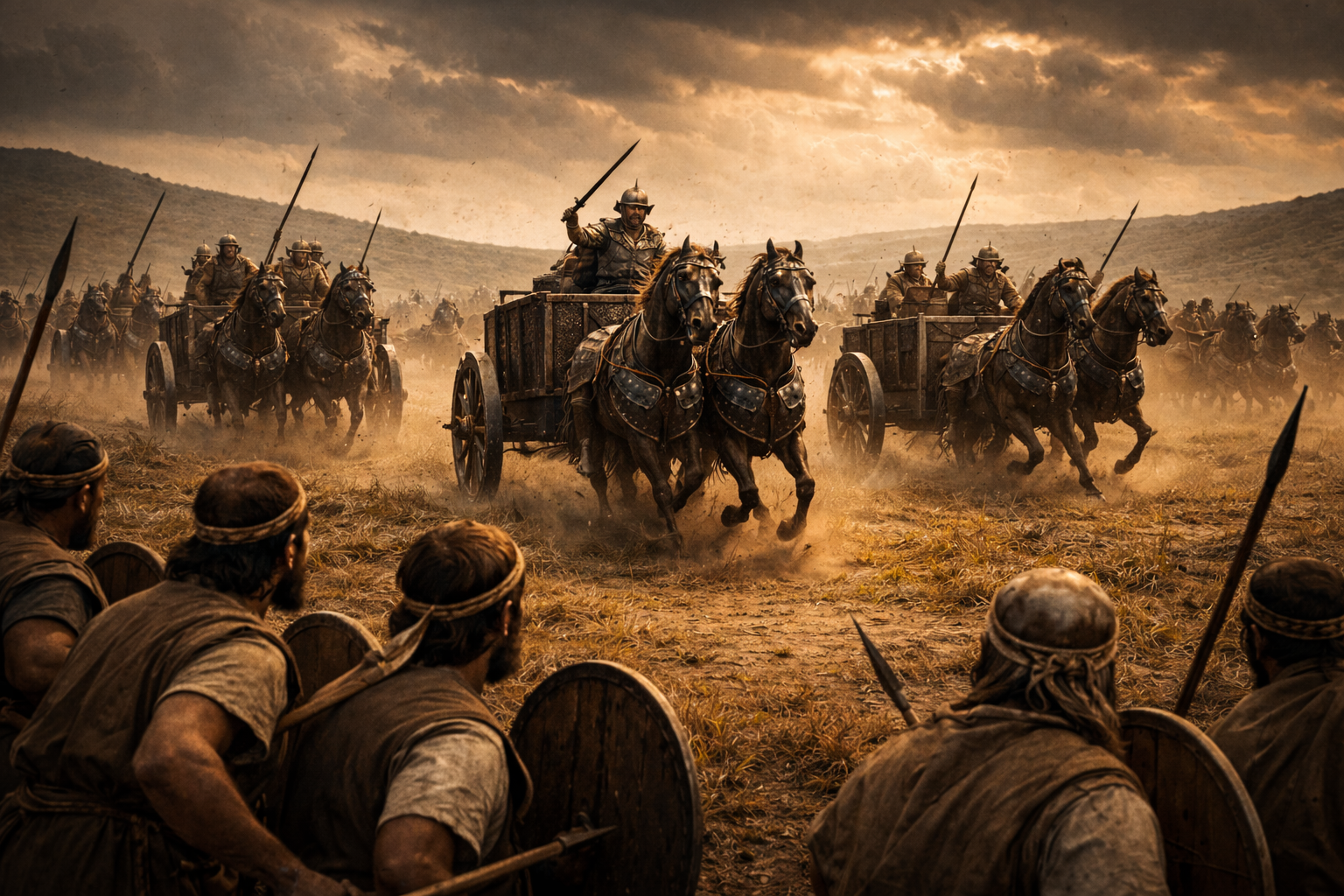
Iron chariots represented the most advanced military technology of the time. Against them, Judah’s usual strategies were ineffective.
Despite God being with them, Judges introduces a difficult but necessary category: God’s presence does not always mean God acts instead of His people. His presence empowers obedience, but it does not bypass dependence, courage, or the exposure of weakness.
Sometimes faithfulness brings us precisely to the point where our strength runs out.
Why this verse can be unsettling
Many readers instinctively try to smooth this verse over.
We assume Judah must have lacked faith. Or failed to try hard enough. Or fallen short in some hidden way.
But Judges does not say any of that in relation to this situation.
It simply holds two truths together:
- God was with them.
- They could not do it.
That combination is uncomfortable, because it suggests that ongoing struggle is not always evidence of disobedience. Sometimes it is evidence of limitation.
And Judges shows us that what happens after that moment matters greatly.
The danger of unresolved strongholds
Judges does not linger on the iron chariots, but it does trace their consequences.
The inhabitants who are not driven out are eventually:
- Put to forced labour
- Tolerated
- Accommodated
- Interwoven into Israel’s life
What Israel does not remove, they learn to live with. What they live with, they eventually serve.
Judges is not a story of sudden apostasy. It is a story of gradual compromise.
That pattern turns Judges 1:19 into a warning, especially when we read it as part of the sanctification story.
An "iron chariot" many believers recognise: Anger
Most Christians can point to real and decisive change after coming to faith.
At some point major sins fall away, old habits break, and destructive patterns end.
This is real grace. God is genuinely at work.
But then the terrain changes.
Life settles into routine. Pressure builds. Fatigue creeps in. Relationships strain.
And suddenly there is one area that refuses to yield.
For many believers, that area is anger.
Not explosive rage. Not public outbursts. But persistent, reactive anger that surfaces under pressure.
- Irritation with children or a spouse
- Sharpness in conversation
- Resentment at work
- Contemptuous thoughts toward others
- A short fuse when things feel out of control
The person prays, repents, and resolves to do better. And yet it returns.
God is still present and the person's faith is still real. In fact, growth is still happening in other areas.
... but this remains.
Anger, and other strongholds of our old personality, reflect Judges 1:19 lived out.
Why anger functions like an iron chariot
Anger often persists because it is not merely a behaviour. It is a protector.
It guards:
- Control (“things must go my way”)
- Justice (“this is not fair”)
- Identity (“I must not be diminished”)
- Fear (“something bad will happen if I don’t react”)
This is why anger so often resurfaces in moments of stress. The terrain has flattened and the chariots have room to run.
Discipline and resolution alone struggle, and often fail, here.
Anger is rarely defeated by trying harder. It exposes the limits of self-reliance.
The fork in the road: manage or trust
When a believer encounters a persistent sin like this, two responses are common.
Some choose accommodation.
They rename it. “That’s just my personality.” “I’m under a lot of pressure.” “Everyone has something.”
Like Israel, they stop fighting and learn to coexist. The stronghold remains, but it is managed rather than confronted.
Others choose escalation of self-effort.
They implement more rules, monitoring, accountability and attempted control.
This can restrain outward behaviour for a time, but it often produces rigidity, anxiety, or quiet pride. The land looks orderly, but freedom is thin.
Iron chariots rarely fall to effort.
The lessons in Judges may point us toward a third way.
Why God allows iron chariots to remain
Some battles remain because they expose where our obedience is still leaning on ourselves.
Anger persists not simply because we lack discipline, but because we are still trusting anger to protect us.
God allows the iron chariots to remain, not to shame us, but to bring us to the end of self-reliance.
They force different prayers.
Not only: “Help me stop doing this,” but: “Why do I need this?” “What am I protecting?” “Teach me to trust you here.”
Sanctification has not stalled. If we respond appropriately. it deepens.
Hebrews and the invitation to rest
The New Testament looks back on Israel’s story and draws a sober conclusion.
In Hebrews 3–4, believers are warned not to stop short of rest.
Israel failed to enter rest not because the promise was false, but because trust gave way to fear and self-reliance.
Rest is not passivity, but rather is the peace that comes through settled trust.
Iron chariots mark the boundary where self-effort ends and dependence must grow.
God with us, even here
Judges 1:19 will not let us draw easy conclusions.
God is with Judah. The iron chariots remain.
Both are true.
This verse does not teach us that God leaves us when we struggle. It teaches us that some struggles exist precisely to expose where we still trust ourselves.
Anger that persists is not proof of God’s absence. It may be the very place where God is inviting deeper freedom.
Iron chariots can be invitations to dependence, rather than signs of failure.
And in time, as trust grows where self-reliance once ruled, even iron chariots fall.