Jesus Gave Us His Life
Jesus gave his life for us at the cross, and he gives his risen life to us through union with him. Eternal life is found in the Son because he is our life.
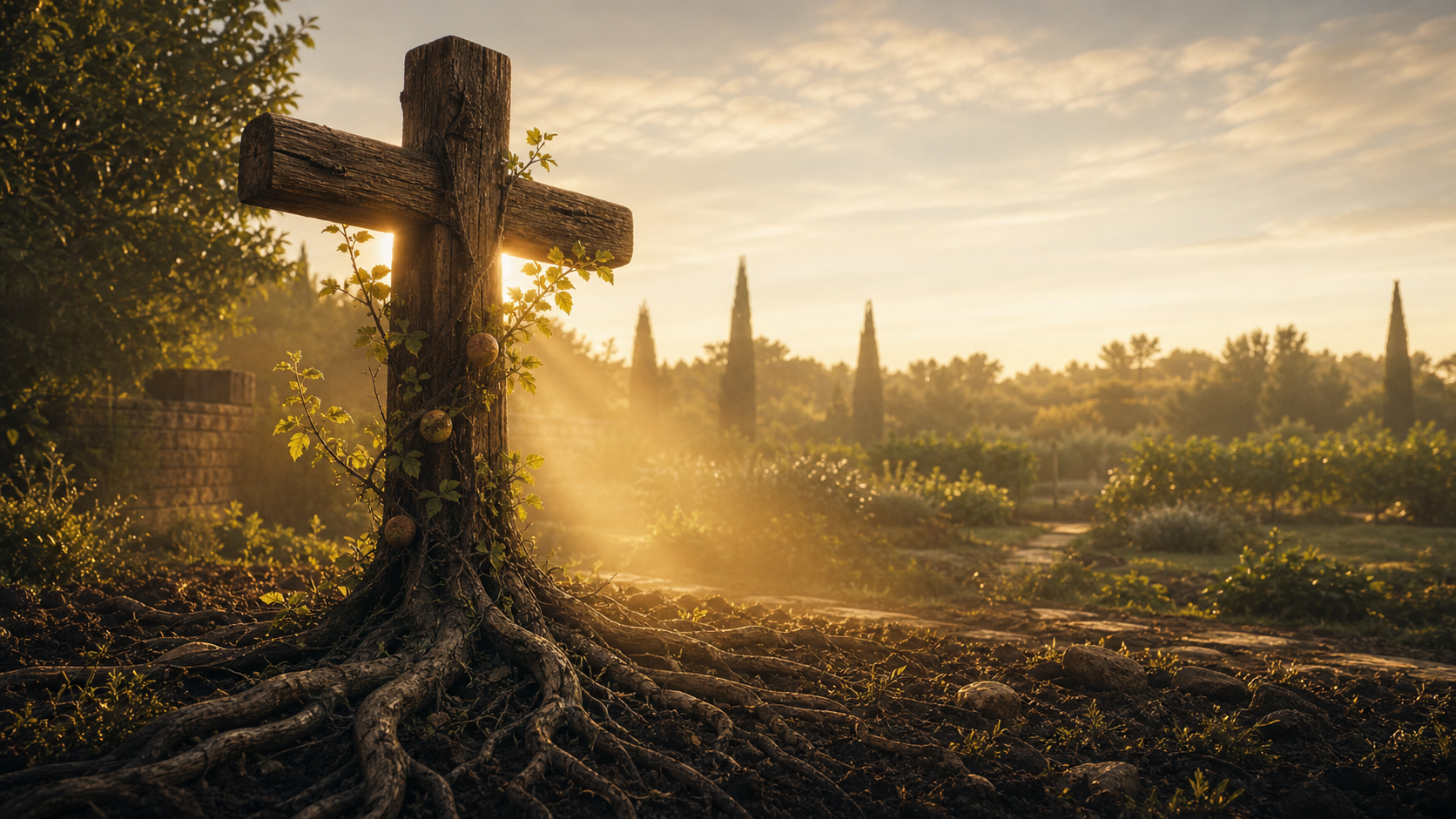
When Christians say Jesus gave His life for us, we usually mean He died for us.
And that is gloriously true.
He is the Lamb of God who takes away the sin of the world. He bore our sins in His body on the tree. He stood in our place. He drank the cup. He died the death that belonged to us so that we could receive the life that belongs to Him.
But Scripture gives the phrase more depth than we sometimes notice.
Jesus gave His life for us at the cross. He also gives His life to us by joining us to Himself.
That is the fruit of the cross.
The gospel is not that Jesus died so that forgiven sinners could go back to living from their own resources. The gospel is that Jesus died and rose again so that His own risen life could become ours. He does not simply remove guilt. He gives life. He does not simply cancel death. He shares His resurrection.
John says it plainly:
“And this is the testimony, that God gave us eternal life, and this life is in his Son.”
1 John 5:11
John does not say the life is merely given by the Son. He says the life is in the Son. Eternal life is not a substance God hands us apart from Christ. It is not merely an extended version of our old life. It is not bare existence that happens to last forever. Eternal life is found in the Son because eternal life is the Son’s own life given to us.
Jesus said, “I am the resurrection and the life” (John 11:25). He said, “I am the way, and the truth, and the life” (John 14:6). John began his Gospel by saying, “In him was life, and the life was the light of men” (John 1:4).
Jesus is not simply alive.
He is life.
So when He gives us eternal life, He gives us Himself. He brings us into union with Him. He makes His life the hidden source of ours.
Paul says, “I have been crucified with Christ. It is no longer I who live, but Christ who lives in me” (Galatians 2:20). That is not religious exaggeration. Paul is describing the strange and wonderful reality at the center of the Christian life. The old self has been crucified with Christ. A new life has begun. And that new life is not generated from within Paul as though he has become spiritually impressive. It is Christ living in him.
This is why salvation is bigger than pardon, though it never becomes less than pardon. Forgiveness is real. Justification is real. The sacrifice is real. The blood is real.
But the Lamb who died is also the Lord who lives.
Paul says it this way in Romans:
“For if while we were enemies we were reconciled to God by the death of his Son, much more, now that we are reconciled, shall we be saved by his life.”
Romans 5:10
Reconciled by His death. Saved by His life.
The resurrection life of Jesus is not a footnote to the cross. The risen life of Christ is part of our salvation. His death reconciles us to God. His life carries us home. His priesthood does not expire because “he always lives to make intercession” for those who draw near to God through Him (Hebrews 7:25).
This means the Christian life is not a memorial service for a dead teacher. It is not a moral improvement program based on the inspiring example of Jesus. It is life from the risen Christ.
Jesus said, “Because I live, you also will live” (John 14:19).
That sentence reaches into the future resurrection, but it also reaches into the present. We live now because He lives now. Our life is tied to His life. Our future is tied to His future. Our standing before the Father is tied to His standing before the Father.
This is what union with Christ means. His death becomes ours. His resurrection becomes ours. His righteousness becomes ours. His sonship becomes ours by grace. His Spirit dwells in us. His future glory becomes our hope.
Paul says God “made us alive together with Christ” and “raised us up with him and seated us with him in the heavenly places in Christ Jesus” (Ephesians 2:5-6). That is almost too much to take in. Believers are still on earth. We still suffer. We still sin. We still wait for the redemption of our bodies. Yet Scripture says we have already been made alive with Christ, raised with Christ and seated with Christ.
Our life is larger than it looks.
Colossians says, “For you have died, and your life is hidden with Christ in God” (Colossians 3:3). Then Paul adds, “When Christ who is your life appears, then you also will appear with him in glory” (Colossians 3:4).
Christ who is your life.
Not Christ who improves your life. Not Christ who adds a religious layer to your life. Christ who is your life.
This also helps us understand eternal life more clearly. We often speak of eternal life as something that starts after death. Scripture speaks differently. Jesus says, “Whoever hears my word and believes him who sent me has eternal life” (John 5:24). Has. Present tense. He also says that the believer “has passed from death to life.”
Eternal life begins now because Christ gives Himself to us now.
Of course, it has not yet appeared in fullness. Our bodies still die. Our faith is still tested. Our obedience is still partial and often painfully slow. But the life of the age to come has already entered the present because the risen Christ has given us His Spirit.
Paul says, “If Christ is in you, although the body is dead because of sin, the Spirit is life because of righteousness” (Romans 8:10). Then he goes further: “If the Spirit of him who raised Jesus from the dead dwells in you, he who raised Christ Jesus from the dead will also give life to your mortal bodies” (Romans 8:11).
The Spirit who raised Jesus from the dead dwells in us.
That is not a small claim. The Christian life is not powered by memory, sentiment or willpower. It is the life of the risen Jesus given by the Spirit. “The Spirit of life has set you free in Christ Jesus from the law of sin and death” (Romans 8:2).
This is also why Jesus speaks of Himself as the vine.
“Abide in me, and I in you,” He says. “As the branch cannot bear fruit by itself, unless it abides in the vine, neither can you, unless you abide in me” (John 15:4).
A branch does not bear fruit by admiring the vine from a distance. It bears fruit because the life of the vine flows into it. That is the Christian life. We live from Christ. We bear fruit from Christ. Apart from Him, Jesus says, we can do nothing (John 15:5).
That is humbling. It is also freeing.
It means Christian growth is not self-salvation with Bible verses attached. It is not the old self trying harder to become impressive enough for God. The fruit comes from the life. The life comes from Christ.
Paul says, “For me to live is Christ” (Philippians 1:21). He tells the Galatians that he is in anguish “until Christ is formed in you” (Galatians 4:19). He calls “Christ in you” the “hope of glory” (Colossians 1:27).
Christ for us. Christ in us. Christ our life.
This is where the tree of life starts to come back into view.
In Eden, the tree of life stood in the garden. After Adam and Eve sinned, they were driven out, and the way to the tree of life was guarded (Genesis 3:22-24). Humanity was exiled from life with God. Death entered. The garden was closed.
Then Scripture keeps giving us tree of life language. Proverbs says wisdom is “a tree of life to those who lay hold of her” (Proverbs 3:18). Righteous fruit is called “a tree of life” (Proverbs 11:30). A desire fulfilled is “a tree of life” (Proverbs 13:12). A gentle tongue is “a tree of life” (Proverbs 15:4).
Those Proverbs texts are not all making the same point in the same way. They are wisdom sayings. Still, they keep the image alive. Life with God is fruitful. Wisdom gives life. Righteousness bears life. Speech can become life-giving.
Then Revelation brings the tree of life back at the end of the story. Jesus says, “To the one who conquers I will grant to eat of the tree of life, which is in the paradise of God” (Revelation 2:7). In the new Jerusalem, the tree of life appears again, “with its twelve kinds of fruit,” and “the leaves of the tree were for the healing of the nations” (Revelation 22:2). The curse is gone. The exile is over. The servants of God see His face.
So where does the cross fit?
Peter says Jesus “bore our sins in his body on the tree” (1 Peter 2:24). Paul says, quoting Deuteronomy, “Cursed is everyone who is hanged on a tree” (Galatians 3:13).
The cross is the tree where the curse falls on Christ.
And because the curse falls on Him, life comes to us.
That is the glory of the cross. The instrument of death becomes, by the wisdom and mercy of God, the place where life is given. The tree of curse becomes the tree from which the fruit of eternal life is given to the world.
The Bible does not give us a simple sentence that says, “The cross is the tree of life.” But the biblical pattern is hard to miss. Humanity is barred from the tree of life because of sin. Christ bears sin on the tree. Through His death and resurrection, the way to life is opened. In Revelation, those who belong to Him eat from the tree of life in the paradise of God.
The fruit of the cross is life.
This is why Jesus can say, “I came that they may have life and have it abundantly” (John 10:10). He is not promising a more comfortable version of the old life. He is giving the life that exists in Him: Sonship before the Father, communion with God, resurrection hope, freedom from condemnation, the Spirit within us and a future body like His glorious body.
That life is already ours in Christ, though we still wait to see it in full.
This changes how we think about the gospel. If we only think of Jesus giving His life in the sense that He died, we may start to imagine salvation as a transaction that leaves us mostly untouched. Jesus pays the debt. We are cleared. Heaven is secured. Now we try to be better.
There is truth in parts of that, but it is too thin.
Jesus did not die to leave us as forgiven versions of Adam. He died and rose again to make us alive in Himself. He brings us into a new humanity. He is the last Adam, and Paul says He became “a life-giving spirit” (1 Corinthians 15:45). The risen Christ gives life to His people by the Spirit.
That means the Christian life is received before it is expressed. We love because His life is at work in us. We obey because His life is at work in us. We endure because His life is at work in us. We bear fruit because we abide in the vine.
And when we fail, which we do, our hope is still His life. We do not crawl back to God with the strength of our repentance as our confidence. We come through the living Christ. We come because He is our righteousness. We come because He lives to intercede. We come because our life is hidden with Christ in God.
There is deep comfort here.
Your life in Christ is not as fragile as your feelings. It is not as unstable as your obedience. It is not exposed to every accusation, fear and failure as though it stands alone. Your life is hidden with Christ in God.
Hidden does not mean imaginary. Hidden means kept. Hidden means the world cannot fully see it yet. Hidden means even you cannot fully see it yet.
One day Christ will appear. And when He appears, Paul says, “then you also will appear with him in glory” (Colossians 3:4). What is hidden now will be revealed then. The life that feels weak now will be shown for what it really is: the life of the risen Son shared with His people.
So yes, Jesus gave His life for us.
Bless God, He did.
But He also gives His life to us. The Lamb who died is the Lord who lives. The cross does not merely remove death. It bears the fruit of life. And the life God gives is in His Son.