From Enemies to Joy

An Exposition of Romans 5:7–11
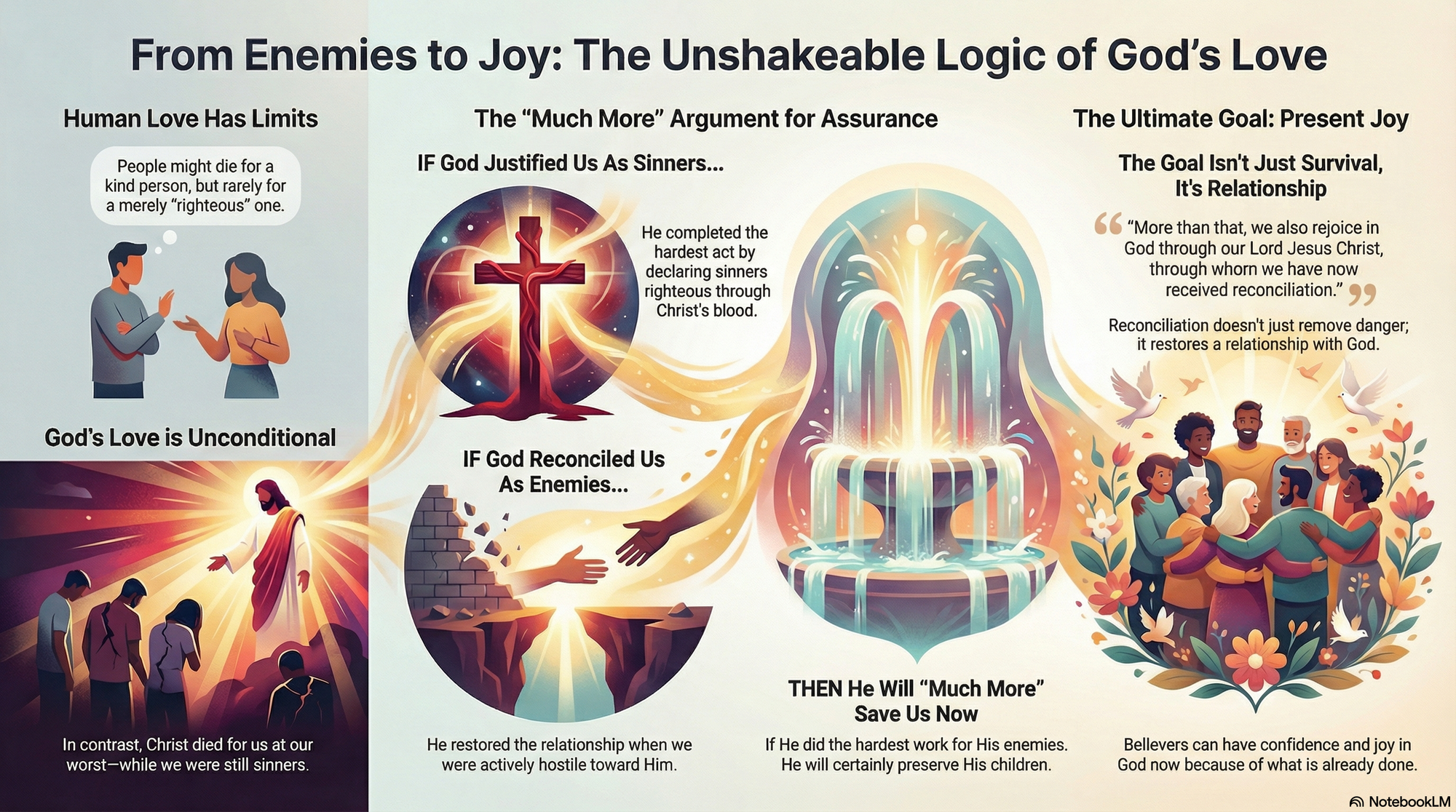
One of Paul’s great concerns in Romans is assurance. He is not only explaining how God saves, but helping believers rest in the certainty of what God has done. Romans 5:7–11 sits at the heart of that concern. In these verses, Paul layers logic upon logic to show that God’s saving work in Christ is not fragile, provisional, or reversible. It is secure, complete, and meant to lead not merely to safety, but to joy.
Human Love at Its Limits (Romans 5:7)
Paul begins by appealing to ordinary human experience:
“For one will scarcely die for a righteous person—though perhaps for a good person one would dare even to die.”
At first glance, this can feel backwards in English. Is not a righteous person better than a good one? The Greek clarifies the distinction.
A “righteous” person (dikaios) is upright, just, and morally correct. They do what is right. Such a person is respectable, but not necessarily warm or generous. A “good” person (agathos), however, is benevolent and actively kind. This is someone whose goodness spills over into the lives of others.
Paul’s point is not to rank virtue, but to explore motivation. Few people would die for someone who is merely upright and principled. But someone might conceivably lay down their life for a person who has shown extraordinary kindness and love.
Even then, Paul says, this would be rare.
God’s Love Against All Expectation (Romans 5:8)
Paul now introduces the contrast that drives the passage:
“But God shows his love for us in that while we were still sinners, Christ died for us.”
Human love, at its very best, might reach toward the deserving. God’s love moves in the opposite direction. Christ did not die for the righteous or the good, but for sinners. This is not love responding to worth. It is love creating worth where none existed.
This establishes the pattern Paul will repeat. God’s saving work begins at the point of maximum unworthiness and maximum cost.
The “Much More” of Assurance (Romans 5:9)
Paul now draws a conclusion:
“Since, therefore, we have now been justified by his blood, much more shall we be saved by him from the wrath of God.”
This is not merely repetition, but Paul actually escalating the point.
To be “justified by his blood” is legal language. It means that a verdict has already been issued. The believer has been declared righteous before God on the basis of Christ’s death.
“Saved from wrath,” however, is future-facing. It concerns final judgment and the outcome of history.
Paul’s logic is deliberate. If God has already done the hardest thing, justifying sinners at the cost of his Son’s blood, then the lesser thing necessarily follows. God will not reverse his own verdict. Wrath is what justification rescues us from. It is not something that still hangs over those who have been declared righteous.
The phrase “much more” signals this. The costly act has already occurred. The future outcome is therefore secure.
From Courtroom to Relationship (Romans 5:10)
Paul restates the argument, but now changes imagery:
“For if while we were enemies we were reconciled to God by the death of his Son, much more, now that we are reconciled, shall we be saved by his life.”
The language has shifted. Justification belongs to the courtroom. Reconciliation belongs to the family.
Paul intensifies the description of our former state. We were not only sinners. We were enemies. This speaks of real alienation and real hostility. And yet, reconciliation took place precisely at that moment.
Notice the direction. Paul says we were reconciled to God. The problem was not God’s reluctance to love, but our estrangement from him.
Then Paul adds a new contrast. Reconciliation happened through Christ’s death. Salvation’s completion is now bound up with Christ’s life. The risen Christ is not a passive figure in the past, but an active, living Savior who brings the work to its intended end.
If death accomplished reconciliation, life will certainly complete salvation.
Again, the logic is from greater to lesser. If God reconciled enemies, he will not abandon those who now belong to him.
The Goal Is Joy, Not Mere Survival (Romans 5:11)
Paul concludes by lifting the reader beyond logic into lived experience:
“More than that, we also rejoice in God through our Lord Jesus Christ, through whom we have now received reconciliation.”
This is the destination of the argument.
The God who was once the object of fear is now the object of joy. Reconciliation does not merely remove danger. It restores relationship. Believers do not merely rejoice in salvation as a concept, but rejoice in God himself.
And once again, Paul emphasizes the present reality. Reconciliation is not something hoped for in the future. It is something already received.
The Shape of Paul’s Argument
Across these verses, Paul builds a steady and cumulative case:
Christ died for us at our worst. Justification has already been accomplished at immense cost. Wrath is therefore no longer our future. Enemies have been reconciled. The living Christ ensures the work will be completed. The result is peace, confidence, and joy in God himself.
The message is simple but profound. The Christian life is not held together by anxiety about whether God will change his mind. It is grounded in what God has already done and who Christ is now.
Paul wants believers not merely to endure the future, but to face it with confidence and joy.