The Knowledge of the Glory of the LORD
“For the earth will be filled with the knowledge of the glory of the LORD, as the waters cover the sea.” Habakkuk 2:14
That verse is often quoted as a promise that one day everyone will know who God is. But that is not actually what it says.
Habakkuk does not say the earth will be filled with the knowledge of the LORD. He says it will be filled with the knowledge of the glory of the LORD.
I believe that distinction is more significant than we might give it credit for at face value.
Glory Is Weight
In Hebrew, the word translated “glory” is kābôd. Before it ever means radiance, splendour, or honour, it means something far more basic.
Kābôd means weight.
Something weighty cannot be ignored. According to the laws of physics, mass actually alters the space around it. That's how gravity works. It's why we stay on the ground rather than float around. We just don't deal with things weighty enough on a day to day basis to fully appreciate that all objects are reacting to the mass of every other object. Only on a cosmic scale does it become obvious. Weight demands response, not permission.
In the Bible text the meaning of kābôd expands to include:
- honour and importance
- splendour and majesty
- reputation and renown
- and finally, the manifest presence of God
But those meanings never leave the root idea behind. Glory is not first about brightness or power. It is about substance.
To glorify God, in biblical terms, is not mainly to speak well of him. It is to recognise that he carries ultimate weight, and that everything else must be oriented in relation to him.
Why Knowledge Alone Is Never Enough
Once you notice this, Habakkuk’s language becomes sharply focused.
Human history is full of knowledge without weight. People acknowledge God while continuing in violence, exploitation, pride, and self-glorification. That is precisely the context Habakkuk is addressing.
The problem is not about ignorance so much as it is about lightness.
Human kingdoms try to fill the earth with their own names, their own monuments, their own gravitational centres. But these glories are thin. They cannot hold. They collapse because they lack real mass.
Against this backdrop, God makes a promise that cuts through illusion.
The earth will be filled, not merely with information about God, but with the knowledge of his glory, meaning a recognition of his true weight, his unignorable reality, his presence that exposes everything false.
Glory and Gravity
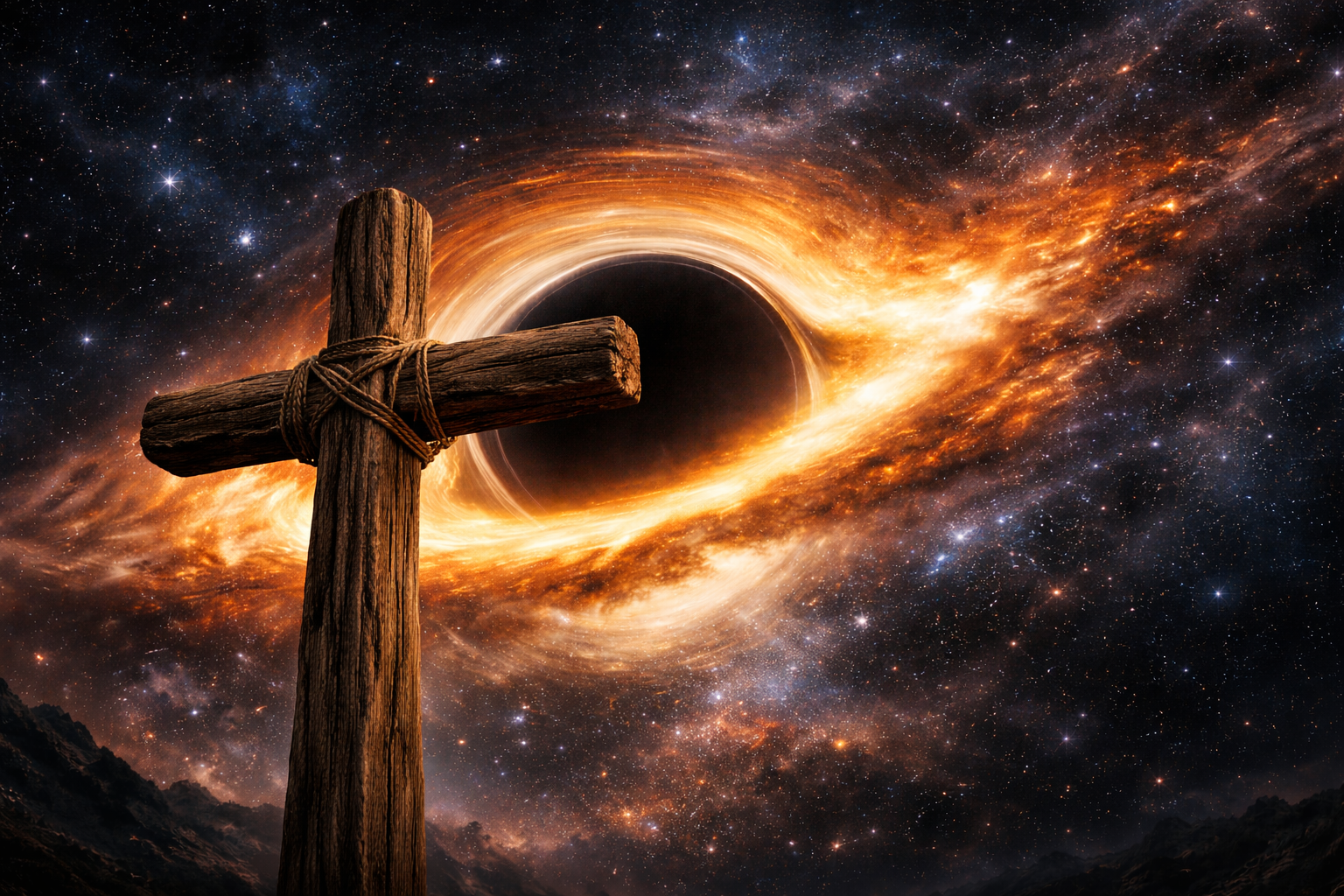
In the physical world, the clearest illustration of weight, density and mass is a black hole.
A black hole is not defined by what it emits, but by what it contains. Its mass is so concentrated that its gravitational pull becomes unavoidable. Nothing interacts with it neutrally. Everything that comes near it must respond.
You do not see a black hole directly. You know it by its effects. By how it bends space. By how it draws everything into relation with itself.
This gives us a surprisingly helpful way to think about biblical glory.
Glory is not spectacle. Glory is concentrated weight.
Eden: Humanity Meant to Bear Weight
The Bible begins with humanity created to carry real weight.
Made in God’s image. Given dominion. Placed in a world where God walks with his creatures. Psalm 8 later says humanity was crowned with glory and honour. That is not flattery. It is responsibility. Weight entrusted to finite beings.
But when humanity seeks glory apart from God, something breaks.
Shame appears. Fear follows. Exile comes next.
God’s glory does not disappear, but humanity can no longer stand comfortably in its presence. The problem is not that God has become heavier. It is that humanity has become lighter.
Israel: Glory Contained, Not Yet Shared
In Israel’s story, God’s glory returns in limited form.
It descends on Sinai with terrifying force. It fills the tabernacle and later the temple. God dwells among his people, but not within them. The glory has weight, but it remains guarded, contained, dangerous.
When Israel treats God as manageable or optional, the prophets describe something devastating. God’s glory departs the temple. Exile is not merely political defeat. It is the withdrawal of divine presence.
And yet, the prophets insist that this is not the end. Habakkuk’s promise belongs here.
One day, the earth will be filled with the knowledge of the glory of the LORD. Not contained. Not localised. Not guarded behind curtains.
The Shock of the New Testament
In the New Testament, God’s glory does not return as fire on a mountain or light in a building.
It returns in a human life.
John writes, “We have seen his glory,” and he locates it in Jesus. God’s weight is now carried in flesh.
But this is where Scripture takes a turn no one could have predicted.
God does not simply reveal his weight. He takes weight upon himself.
The Cross as the Densest Point of Glory
Crucifixion was designed to make a life seem weightless. It stripped a person of honour, agency, and significance. It was meant to declare, “This does not matter.”
Yet the New Testament insists that this moment is the moment of glorification.
What if the cross is not the absence of glory, but its greatest density?
At the cross, Christ draws into himself:
- human violence
- injustice and exploitation
- guilt and shame
- rebellion and death
Not to scatter them, but to bear them.
Like a gravitational centre, the cross gathers what would otherwise tear creation apart. Nothing remains untouched. Nothing remains neutral.
This is not glory as domination. It is glory as self-giving weight.
God does not overcome sin by standing above it. He overcomes it by becoming heavy enough to carry it without collapsing.
The Resurrection
A black hole, if left to itself, would seem like an end point. But the gospel insists otherwise.
The resurrection is God’s declaration that the weight Christ bore did not destroy him. Love proved stronger than death. Faithfulness proved heavier than sin.
Glory is not diminished by the cross. It is vindicated.
Jesus rises not by shedding humanity, but by glorifying it. Humanity, for the first time since Eden, is shown capable of bearing the full weight of God’s presence.
Habakkuk Fulfilled
So when Habakkuk promises that the earth will be filled with the knowledge of the glory of the LORD, he is not predicting mass religious awareness.
He is pointing toward a world where the true centre of gravity is finally recognised.
A world where false glories lose their pull. Where power without love is exposed as empty. Where everything is drawn into right relation with the God who has shown himself strong enough to bear the weight of the world.
Revelation completes the vision. God’s glory fills the renewed creation. No temple is needed. No barrier remains. Humanity is finally able to live in the presence it was made for.
Relevance Today
We live in an age overflowing with knowledge and starving for weight.
We know many things about God, theology, ethics, and history. But Scripture insists that what transforms the world is not information alone, but the knowledge of glory.
To know the glory of the LORD is to be changed by the weight of who God truly is.
Habakkuk’s promise is not small.
It is the promise that the whole earth will one day recognize the only One truly heavy enough to hold everything together.